WHITE PINE {Pinus strobus}
White Pine is a traditional evergreen ally long associated with respiratory support, tissue protection, and seasonal resilience. Its needles, resin, and inner bark have been used in herbal practice to calm irritation, support comfortable breathing, and reinforce the body’s natural barriers during cold and demanding conditions. As a preparation, white pine reflects endurance—working steadily to protect exposed systems and assist the body’s gradual return to balance.
CABINET STUDIES
WHITE PINE
Pinus strobus
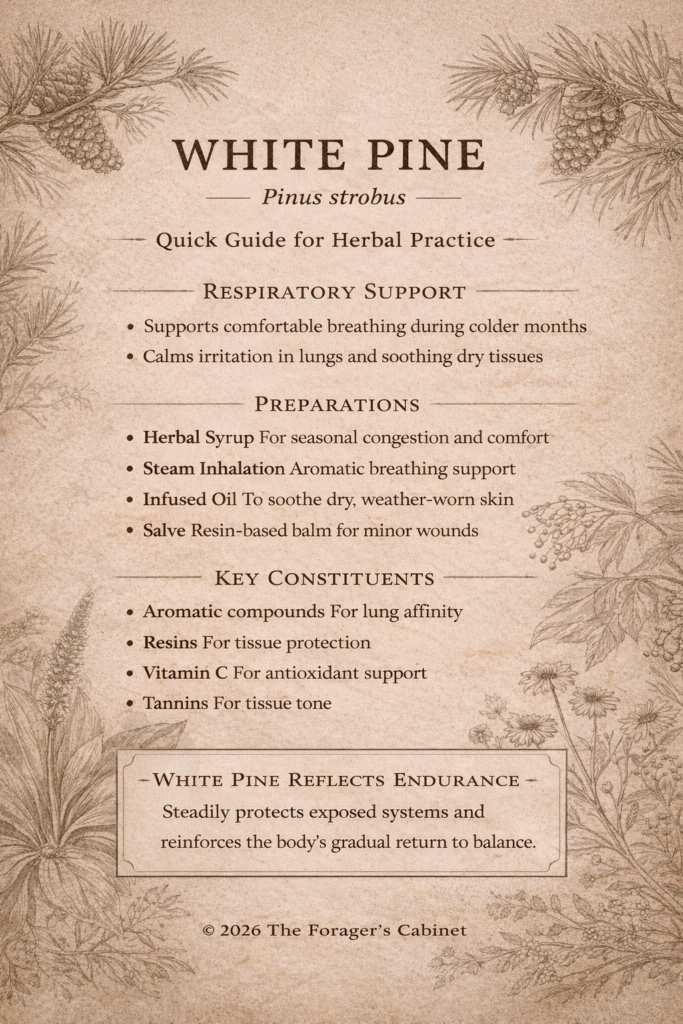
• Respiratory Ally • Tissue Protector • Winter Medicine
Working with White Pine
White pine stands as one of the quiet sentinels of the northern forest. Tall, soft-needled, and aromatic, it holds within its resin and needles a long tradition of use in supporting breath, tissue integrity, and seasonal resilience. Unlike the sharper, more aggressive medicines, pine works steadily—cooling irritation while strengthening weakened or exposed systems.
Its presence is most often associated with winter and early spring, when the air is cold, circulation slows, and the lungs and tissues are asked to endure harsher conditions. In these seasons, white pine offers both protection and restoration, acting as a bridge between exposure and recovery.
Botanical Profile
White pine is a long-lived evergreen native to eastern North America. It can reach heights exceeding 150 feet, identifiable by its soft blue-green needles growing in clusters of five and its tall, straight trunk marked by gray, furrowed bark.
Nearly every part of the tree has been used in traditional practice, though the needles, inner bark, and resin are most commonly prepared. The needles retain their potency year-round but are often gathered during colder months, when their aromatic compounds are especially concentrated.
White pine thrives in well-drained soils, forest edges, and open woodlands, often serving as one of the first trees to establish in recovering landscapes.
Traditional Record
White pine has long been valued in North American herbal traditions for its relationship with the lungs and upper respiratory tract. Its needles were traditionally prepared as teas, syrups, and steam inhalations to support comfortable breathing during periods of cold, congestion, or seasonal illness.
The inner bark was used when deeper tissue support was needed, particularly where dryness, irritation, or structural weakness were present. Resin was applied externally as a protective covering for minor wounds, reflecting pine’s longstanding association with preservation and defense.
Rather than forcing rapid change, pine preparations were used to strengthen the body’s ability to restore balance gradually.
Active Constituents
White pine contains a range of naturally occurring compounds that contribute to its traditional role:
- Volatile aromatic compounds, which contribute to its recognizable forest scent and respiratory affinity
- Resins, which provide protective and stabilizing qualities
- Vitamin C and antioxidant compounds present in the needles
- Astringent tannins, supporting tissue tone and integrity
These constituents work together to calm irritation, protect exposed tissue, and support the body’s natural repair processes.
Preparation Methods
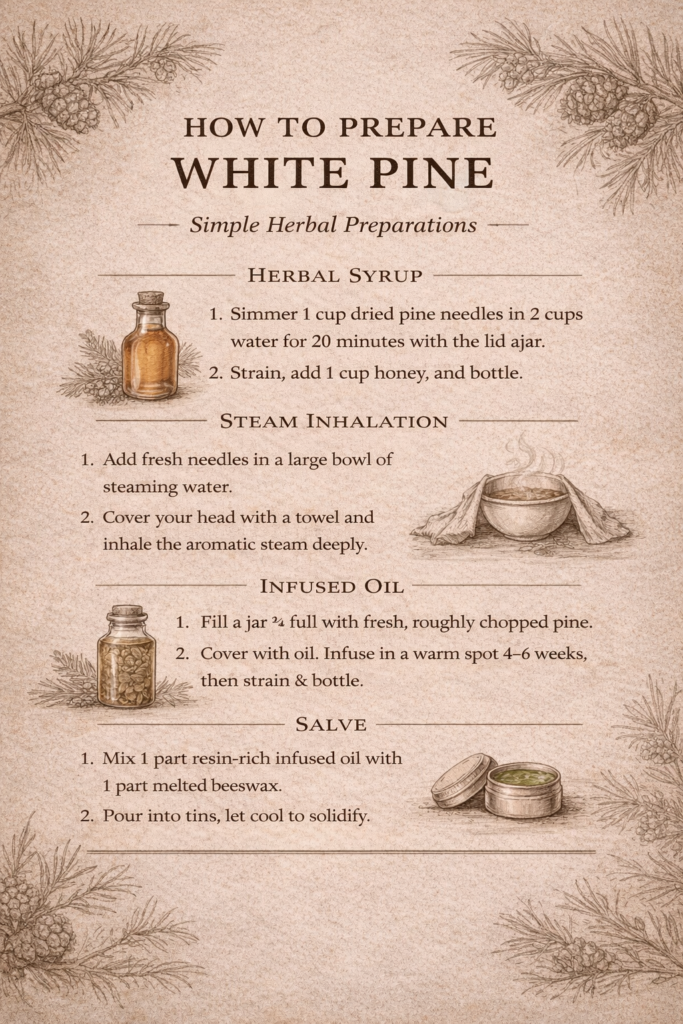
White pine may be prepared in several traditional forms, depending on the intended use:
- Infused Oil
Used externally to support dry, weather-exposed, or irritated skin. - Herbal Syrup
Prepared for seasonal respiratory support and throat comfort. - Steam Inhalation
Used to deliver aromatic compounds directly through the breath. - Salve
Applied externally to protect and restore compromised skin. - Tea or Decoction
Prepared from needles for gentle internal support.
Each preparation emphasizes pine’s protective and restorative qualities rather than rapid or aggressive intervention.
Cabinet Observations
White pine operates as a stabilizing presence. Its action is neither forceful nor abrupt, but steady and protective. It reinforces weakened barriers—whether in the lungs or the skin—allowing recovery to occur without additional strain.
Its affinity for winter conditions reflects its ecological role. Pine does not retreat during cold months; it persists, maintains structure, and continues its quiet metabolic work beneath snow and frost. In this way, its medicine reflects endurance rather than urgency.
This quality makes white pine particularly suited for preparations intended to support tissues under prolonged environmental stress.
Modern Context
In modern environments, exposure to dry indoor air, temperature fluctuations, airborne irritants, and seasonal stressors places continuous demand on the respiratory system and skin barrier.
White pine preparations offer a traditional approach to supporting these systems by reinforcing natural defenses and encouraging gradual restoration rather than temporary suppression.
Its continued presence in herbal practice reflects both its effectiveness and its compatibility with the body’s existing repair mechanisms.
Safety Record
White pine is traditionally regarded as gentle and well tolerated when used appropriately.
Only correctly identified white pine should be used, as some evergreen species are not interchangeable. External preparations are suitable for most individuals, while internal preparations should be used thoughtfully and in moderation.
As with all herbal preparations, proper identification and preparation are essential.
Closing Reflection
White pine does not rush. It persists.
Through winter, it continues its quiet work—protecting, stabilizing, and enduring. Its medicine reflects this same intelligence: not forcing the body forward, but helping it remain intact until warmth and renewal return on their own.
© 2026 The Forager’s Cabinet — All Rights Reserved
Educational and Personal Responsibility Disclaimer
All content provided by The Forager’s Cabinet is intended for educational and informational purposes only. These materials reflect traditional herbal knowledge, historical record, and personal study, and are not intended as medical advice or as a substitute for professional healthcare. The preparation and use of any herbal or natural remedy is the sole responsibility of the individual. The Forager’s Cabinet assumes no liability for any adverse effects, injury, or misuse resulting from the application of information presented. Always ensure proper plant identification, follow safe preparation practices, and consult a qualified healthcare professional when appropriate.