Rose Hips {Rosa spp.}
Rose hips are the mature fruit of the rose plant, long associated with tissue restoration, nutritive support, and seasonal resilience. Rich in naturally occurring vitamins, antioxidants, and protective compounds, they have been used in herbal practice to replenish depleted systems, support immune integrity, and reinforce the body’s structural defenses during colder and more demanding seasons. As a preparation, rose hips reflect preservation—working steadily to restore what has been diminished and support the body’s gradual return to strength and balance.
CABINET STUDIES
ROSE HIPS
Rosa spp.
• Tissue Restorative • Seasonal Fortifier • Barrier Support
Working with Rose Hips
Rose hips form quietly after the flower has faded. Where petals once opened briefly, the fruit begins its slower work—gathering nutrients, concentrating vitality, and remaining long after more fragile structures have fallen away. In this way, rose hips represent preservation, endurance, and preparation for future repair.
Their traditional use centers on restoring tissues weakened by seasonal exposure, depletion, or prolonged stress. Unlike sharper botanical agents that stimulate rapid response, rose hips nourish steadily, replenishing foundational reserves and reinforcing the body’s structural resilience.
Their affinity is most often associated with late autumn and winter, when environmental conditions demand greater internal support. During these colder cycles, rose hips serve as a restorative presence—supporting recovery while helping maintain integrity through prolonged seasonal strain.
Botanical Profile
Rose hips are the mature fruit of the rose plant, forming at the base of the flower after pollination. As the petals fall away, the ovary swells and ripens into a small, rounded structure, typically red to deep orange in color.
Wild roses producing medicinal hips are found throughout temperate regions of the Northern Hemisphere, thriving along forest edges, open fields, hedgerows, and disturbed ground. These resilient shrubs tolerate harsh conditions and often establish themselves in exposed or transitional environments.
The hips are typically harvested after the first frost, when their structure softens and their internal constituents reach peak concentration.
Within each hip lies a dense concentration of nutritive and protective compounds, preserved within a durable outer skin designed to withstand environmental extremes.
Traditional Record
Rose hips have been valued across numerous herbal traditions for their ability to support recovery, fortify weakened systems, and restore balance after depletion. They were commonly prepared as teas, syrups, and preserves, particularly during colder months when fresh plant foods were scarce.
Their association with winter care reflects their ability to provide gentle, sustained nourishment rather than immediate stimulation. Rose hips were used to support immune resilience, maintain tissue integrity, and assist the body during periods of environmental and seasonal stress.
Rather than forcing physiological change, rose hips were traditionally relied upon to strengthen underlying structures, allowing the body’s natural repair processes to proceed more effectively.
Active Constituents
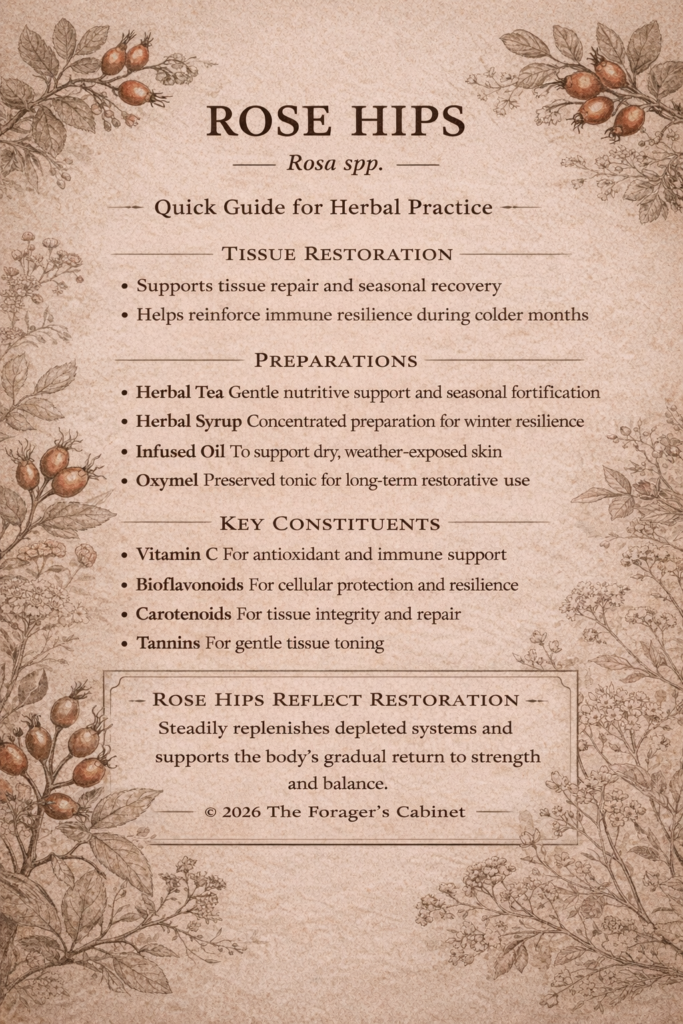
Rose hips contain a broad range of naturally occurring compounds that contribute to their restorative role:
- Vitamin C and associated antioxidant compounds, supporting tissue repair and structural resilience
- Bioflavonoids, which help protect cells from oxidative stress
- Carotenoids, contributing to tissue integrity and cellular protection
- Pectins and organic acids, supporting gentle internal balance
- Tannins, offering mild astringent properties that reinforce tissue tone
Together, these constituents help restore weakened systems, protect vulnerable tissues, and support gradual recovery.
Preparation Methods
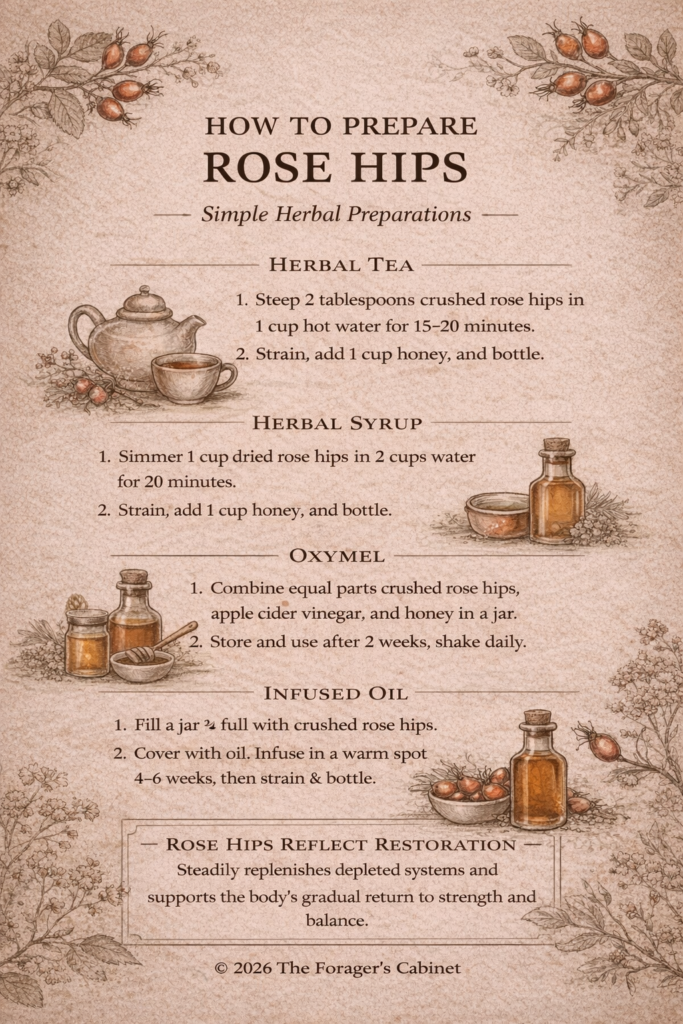
Rose hips may be prepared in several traditional forms, depending on the intended use:
- Tea or Infusion
Prepared to provide gentle internal nourishment and seasonal support. - Herbal Syrup
Used to deliver concentrated nutritive support, particularly during colder months. - Oxymel
Combines rose hips with vinegar and honey for long-term preservation and daily use. - Infused Oil
Prepared for external application to support dry or weather-exposed skin. - Powder
Incorporated into preparations for extended shelf stability and ease of use.
Each preparation emphasizes rose hips’ role as a restorative and fortifying agent.
Cabinet Observations
Rose hips operate through restoration rather than intervention. Their action is gradual, strengthening foundational systems rather than overriding them. They reinforce the body’s natural capacity to maintain integrity under prolonged stress.
Their formation itself reflects this principle. Where the flower is brief, the fruit persists. Where exposure has occurred, protection follows.
This makes rose hips particularly suited for preparations intended to restore resilience after seasonal depletion or environmental strain.
Modern Context
In modern environments, reduced sun exposure, indoor living, and seasonal stressors place continuous demand on the body’s restorative systems. Nutritional depletion and environmental exposure can gradually weaken structural and immune resilience.
Rose hips offer a traditional means of replenishment—supporting recovery by restoring essential nutritive compounds and reinforcing the body’s inherent repair mechanisms.
Their continued use reflects their compatibility with long-term maintenance and seasonal preservation practices.
Safety Record
Rose hips are traditionally regarded as safe and well tolerated when properly prepared.
Seeds and internal hairs should be removed prior to internal preparation, as they may cause irritation if consumed.
As with all herbal materials, proper identification, preparation, and storage are essential.
Closing Reflection
Rose hips emerge only after the flower has passed.
They do not seek attention. They gather strength quietly, preserving what will be needed in the seasons ahead. Their medicine reflects this same function—restoring what has been diminished, reinforcing what has been weakened, and preparing the body for continued endurance.
© 2026 The Forager’s Cabinet — All Rights Reserved
Educational and Personal Responsibility Disclaimer
All content provided by The Forager’s Cabinet is intended for educational and informational purposes only. These materials reflect traditional herbal knowledge, historical record, and personal study, and are not intended as medical advice or as a substitute for professional healthcare. The preparation and use of any herbal or natural remedy is the sole responsibility of the individual. The Forager’s Cabinet assumes no liability for any adverse effects, injury, or misuse resulting from the application of information presented. Always ensure proper plant identification, follow safe preparation practices, and consult a qualified healthcare professional when appropriate.