AMERICAN ELDERBERRY {Sambucus canadensis}
American Elderberry is a deciduous woodland shrub long associated with immune modulation, seasonal resilience, and circulatory support. Rich in anthocyanins, flavonoids, and antioxidant compounds, it has been used in herbal practice to support the body’s response to seasonal illness and environmental stress. Traditionally prepared as syrups, decoctions, and tinctures, elderberry works by mobilizing defense—helping the body respond efficiently and restore equilibrium during periods of exposure. As a preparation, elderberry reflects activation—coordinating immune awareness while preserving systemic balance.
CABINET STUDIES
AMERICAN ELDERBERRY
Sambucus canadensis
• Immune Modulator • Seasonal Support • Circulatory Activator
Working with American Elderberry
American elderberry grows along hedgerows, woodland margins, and stream banks, forming arching shrubs crowned with flat clusters of white blossoms in early summer. By late summer, these blossoms mature into deep purple-black berries, dense with pigment.
This growth pattern reflects its medicinal role. Elderberry supports systems challenged by seasonal transition—particularly when immune resilience has been strained by exposure, environmental stress, or viral activity.
Its action is not suppressive. Rather than forcing the immune system into overreaction, elderberry supports coordinated response—encouraging appropriate activation while maintaining regulation.
Its affinity is most closely associated with early seasonal illness, immune fatigue, and transitional periods between summer abundance and winter contraction.
Botanical Profile
American Elderberry (Sambucus canadensis) is native to North America and thrives in moist soils and transitional landscapes.
It produces compound leaves and broad umbels of creamy white flowers in early summer. By late summer, clusters of dark berries develop, rich in anthocyanin pigments.
The berries are the primary medicinal part, though flowers are also traditionally used.
Raw berries should not be consumed; they are traditionally prepared through cooking or extraction.
Its deep coloration reflects its protective chemistry—dense pigmentation signaling antioxidant concentration and adaptive strength.
Traditional Record
Elderberry has a long record of use across North American and European herbal traditions.
Berries were traditionally prepared as syrups and decoctions to support the body during cold and flu seasons. Elderflower preparations were used to encourage gentle perspiration and support fever regulation.
Its role was to assist the body’s defense rhythm—not to prematurely halt symptoms, but to support efficient resolution.
Elderberry became especially valued for addressing lingering congestion and restoring vitality following seasonal illness.
Its use reflects mobilization—supporting immune readiness while preserving systemic balance.
Active Constituents
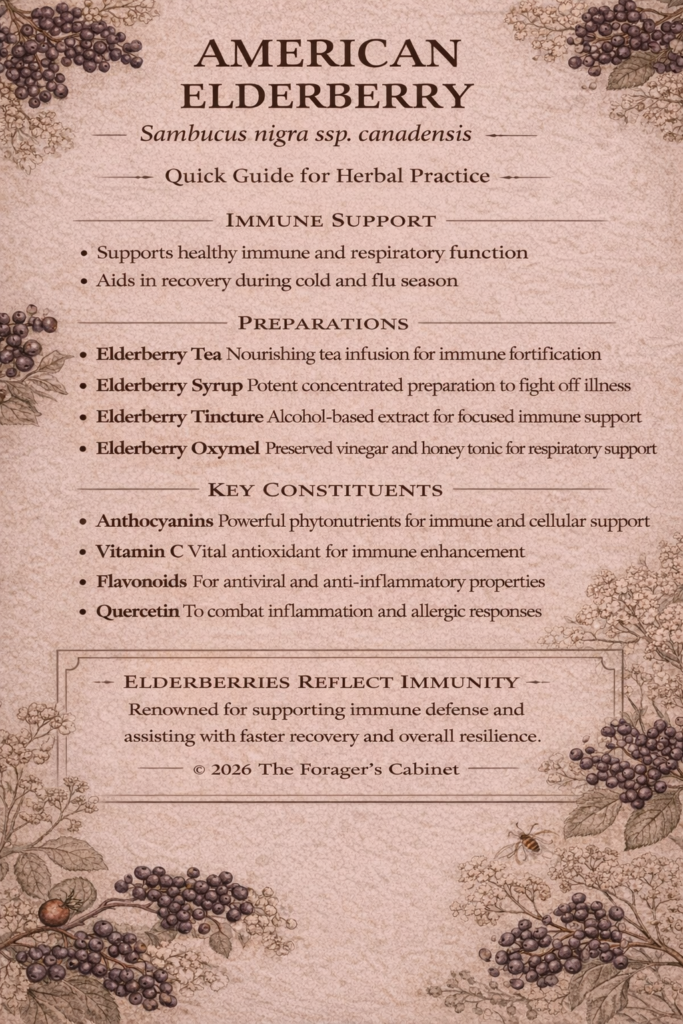
American elderberry contains naturally occurring compounds that contribute to its protective and regulatory properties:
Anthocyanins — Immune-modulating and antioxidant activity
Flavonoids — Supporting vascular and cellular resilience
Phenolic acids — Contributing antioxidant protection
Vitamins and trace minerals — Supporting metabolic and immune processes
Together, these constituents help reinforce immune communication, protect tissues from oxidative stress, and support recovery following seasonal strain.
Preparation Methods
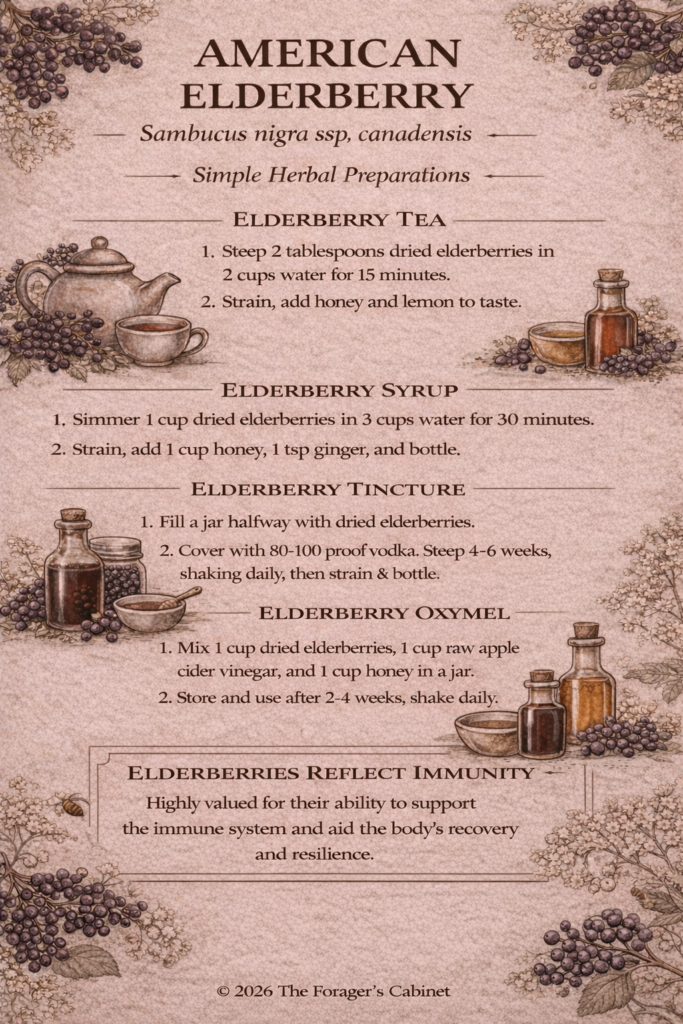
American Elderberry may be prepared in several traditional forms:
Syrup
Prepared from cooked berries and traditionally used during seasonal immune stress.
Decoction
Simmered preparation supporting circulatory and immune activation.
Tincture
Alcohol extraction preserving active compounds for long-term use.
Elderflower Infusion
Prepared from blossoms to support seasonal transition and fever response.
Each preparation emphasizes elderberry’s role as a mobilizing and protective botanical.
Cabinet Observations
Elderberry activates without agitation.
Where defenses have lagged, it sharpens awareness.
Where immune rhythm has faltered, it restores coordination.
Where recovery has slowed, it supports forward movement.
Its medicine is one of readiness.
It does not constrict. It mobilizes.
It does not overwhelm. It directs.
Modern Context
Modern environments place constant demand on immune systems—crowded spaces, viral exposure cycles, environmental pollutants, and chronic stress.
These pressures may blunt responsiveness or prolong recovery.
American elderberry offers traditional support for maintaining adaptive resilience under these conditions—reinforcing immune communication while protecting cellular integrity.
Its continued use reflects compatibility with long-term seasonal immune strategies.
Safety Record
Elderberries must be properly cooked or extracted before use. Raw berries, stems, and leaves contain compounds that may cause gastrointestinal discomfort if consumed improperly.
Prepared correctly, elderberry is traditionally regarded as safe when used appropriately.
As with all herbal materials, proper identification, preparation, and storage are essential.
Closing Reflection
Elderberry grows at the edges—where abundance meets exposure.
It prepares before the season turns.
It mobilizes when challenge approaches.
It restores vitality after strain has passed.
Where defenses have weakened, elderberry renews readiness.
© 2026 The Forager’s Cabinet — All Rights Reserved
Educational and Personal Responsibility Disclaimer
All content provided by The Forager’s Cabinet is intended for educational and informational purposes only. These materials reflect traditional herbal knowledge, historical record, and personal study, and are not intended as medical advice or as a substitute for professional healthcare. The preparation and use of any herbal or natural remedy is the sole responsibility of the individual. The Forager’s Cabinet assumes no liability for any adverse effects, injury, or misuse resulting from the application of information presented. Always ensure proper plant identification, follow safe preparation practices, and consult a qualified healthcare professional when appropriate.