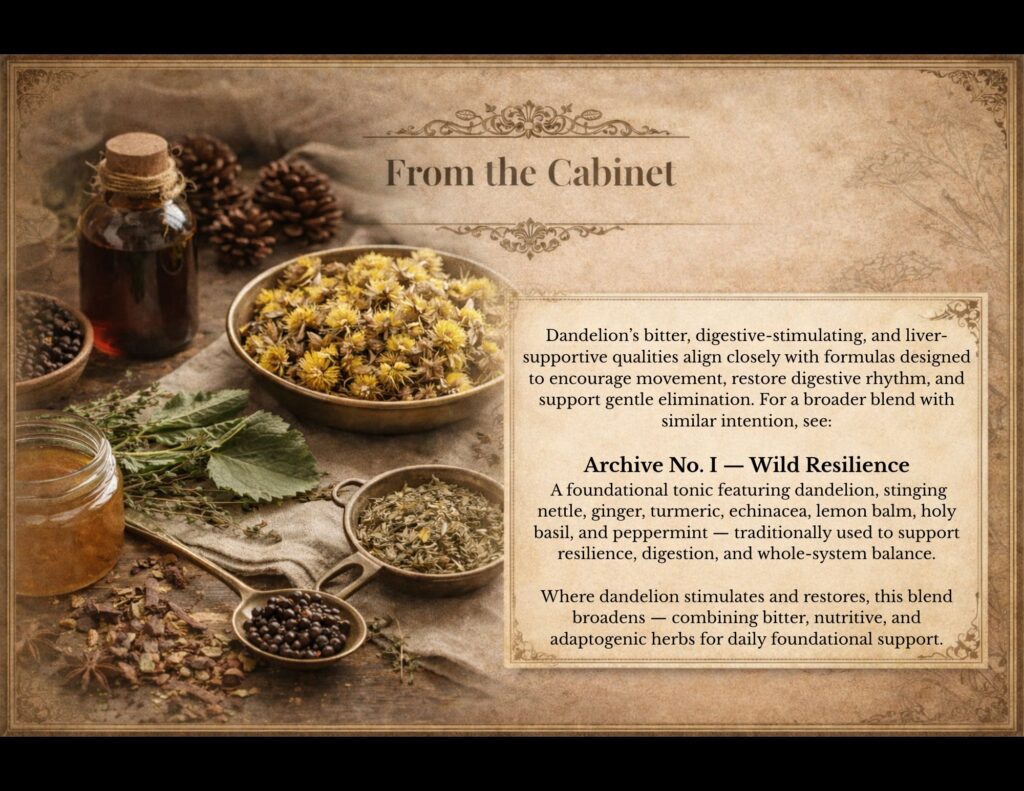
Dandelion {Taraxacum officinale}
Dandelion is a resilient perennial long associated with liver support, digestive stimulation, and gentle systemic cleansing. Rich in bitter compounds, minerals, inulin, and sesquiterpene lactones, it has been used in herbal practice to encourage bile flow, support detoxification pathways, and promote healthy elimination. Traditionally prepared as infusions, decoctions, vinegars, and fresh extracts, dandelion works through activation—stimulating sluggish digestion and supporting natural metabolic flow. As a preparation, dandelion reflects restoration—encouraging movement where stagnation has settled.
CABINET STUDIES
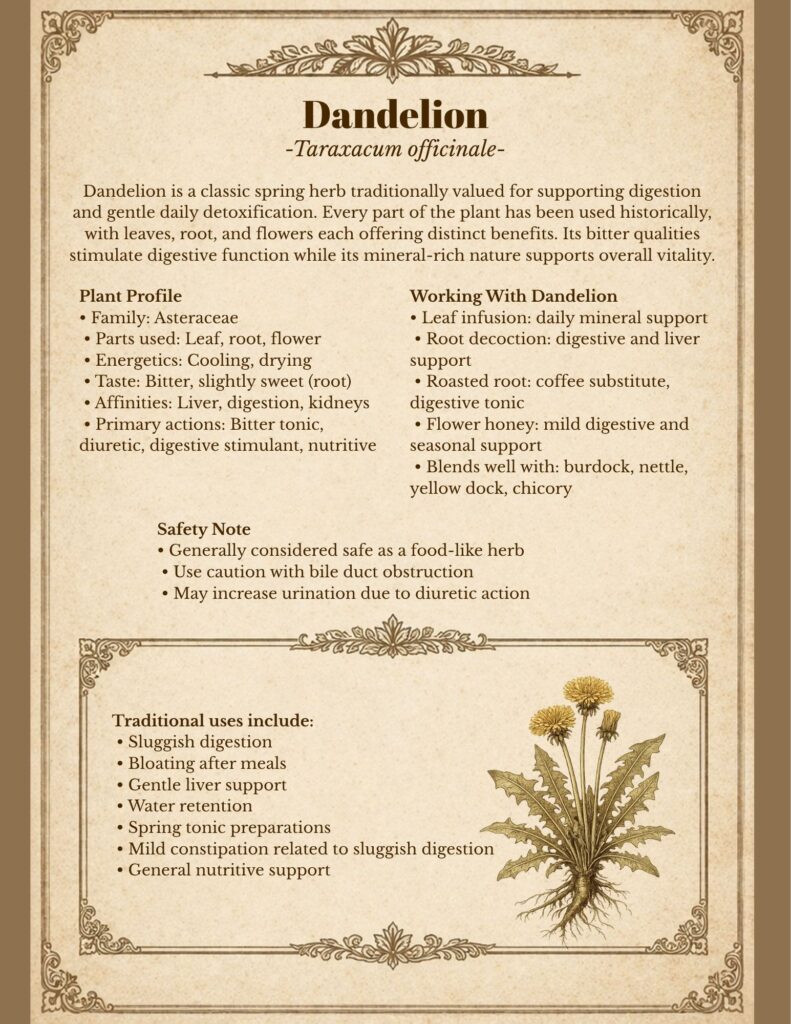
DANDELION
Taraxacum officinale
• Bitter Tonic • Liver Support • Digestive Stimulant •
Working with Dandelion
Dandelion emerges early and persists through the growing season, appearing in lawns, fields, and disturbed soils. Its bright yellow flowers and deeply toothed leaves are among the most recognizable of wild plants.
Its bitterness defines its traditional use. Dandelion stimulates digestive function, supports liver activity, and encourages movement of stagnant systems. Where heaviness, sluggish digestion, or fluid retention are present, dandelion is often considered.
Its action is not aggressive. It works gradually — encouraging gentle restoration of digestive and metabolic rhythm.
It does not force.
It encourages.
Botanical Profile
Dandelion is a hardy perennial widely naturalized throughout North America and Europe. It thrives in compacted soils, lawns, roadsides, and open ground.
A basal rosette of toothed leaves emerges first, followed by hollow stems topped with bright yellow composite flowers. After flowering, the familiar seed head forms — dispersing widely by wind.
The entire plant is traditionally used. Leaves, root, and flower each offer slightly different qualities, though all share bitter and digestive-supportive characteristics.
Its deep taproot reflects its grounding, restorative nature.
Traditional Record
Dandelion holds a long history in European and North American herbal traditions as a digestive and liver-supportive plant. It was commonly used for sluggish digestion, loss of appetite, and general systemic stagnation.
The leaf was traditionally used for fluid balance and gentle diuretic support. The root was valued for liver and digestive stimulation. Flowers were sometimes prepared in wines, syrups, and tonics.
Its traditional role centers on movement — encouraging digestion, elimination, and metabolic activity.
Its use reflects restoration rather than suppression.
Active Constituents
Dandelion contains naturally occurring compounds associated with its traditional digestive and liver-supportive use:
• Bitter compounds — stimulate digestion and liver activity
• Inulin — supports gut microbiome balance
• Flavonoids — antioxidant and supportive activity
• Triterpenes — liver-supportive constituents
• Minerals — especially potassium in the leaf
Together, these constituents help stimulate digestion, support liver function, and encourage gentle elimination.
Preparation Methods
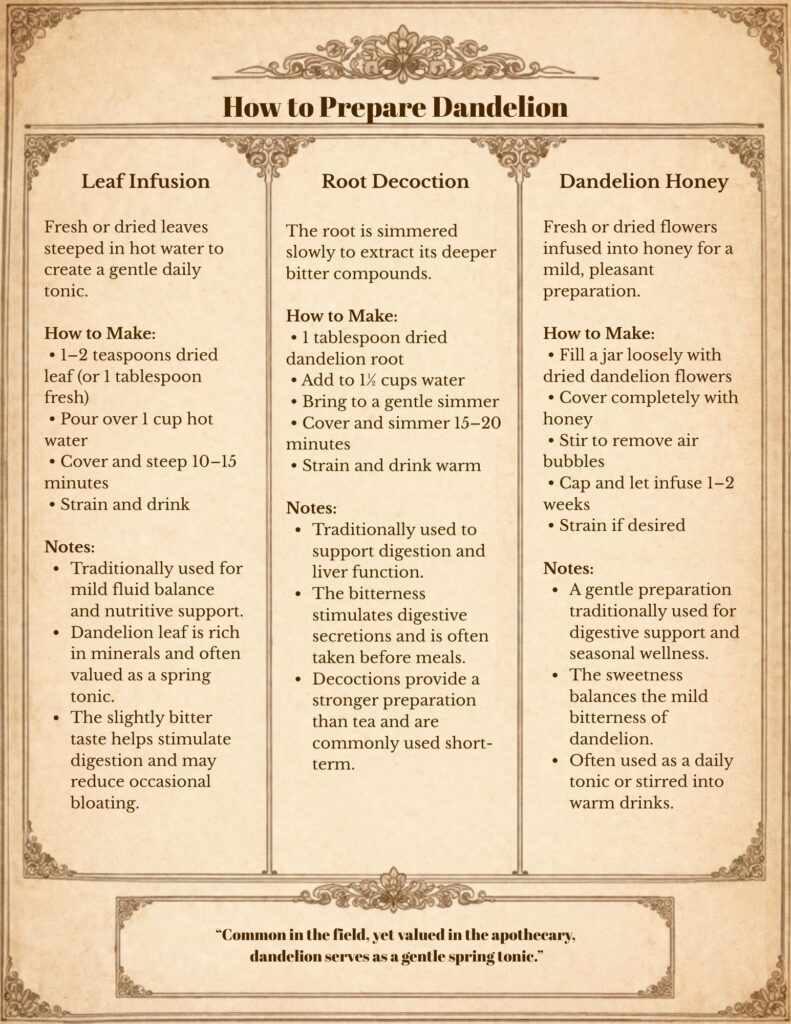
Dandelion may be prepared in several traditional forms:
Leaf Infusion
To Prepare: Pour hot water over dried dandelion leaf, cover, and steep 10–15 minutes. Strain and drink warm.
Traditional Uses:
• Fluid retention
• Digestive sluggishness
• Gentle diuretic support
Root Decoction
To Prepare: Simmer dried dandelion root in water for 15–20 minutes, then strain.
Traditional Uses:
• Liver support
• Sluggish digestion
• Bitter digestive stimulation
Tincture
To Prepare: Macerate chopped fresh or dried root in alcohol for several weeks, then strain.
Traditional Uses:
• Appetite stimulation
• Liver support
• Digestive tone
Roasted Root
To Prepare: Roast dried dandelion root until dark and aromatic, then simmer as a decoction.
Traditional Uses:
• Digestive support
• Gentle liver stimulation
• Coffee alternative bitter tonic
Each preparation emphasizes dandelion’s role as a bitter, restorative botanical.
Cabinet Observations
Dandelion encourages movement.
Where digestion is sluggish, it stimulates.
Where systems are stagnant, it circulates.
Where heaviness is present, it lightens.
Its medicine is one of restoration.
It does not suppress — it encourages.
It does not block — it moves.
It does not force — it restores.
Modern Context
Modern diets, reduced bitterness, and sedentary patterns often contribute to sluggish digestion and liver burden. Dandelion offers traditional support for these patterns.
Its bitterness helps reawaken digestive signaling while gently supporting elimination and metabolic function.
Its continued relevance reflects its role as a foundational bitter tonic.
Safety Record
Dandelion is widely regarded as a gentle, food-like herb traditionally used in moderate amounts. Proper identification is essential.
Those with gallbladder obstruction or sensitivity to bitter herbs should use cautiously. As with all herbs, individual response may vary.
Closing Reflection
Dandelion returns again and again.
It grows where soil is compacted.
It breaks through resistance.
Its medicine restores movement.
It stimulates what is sluggish.
It lightens what is heavy.
Where stagnation persists, dandelion encourages flow.
© 2026 The Forager’s Cabinet — All Rights Reserved
Educational and Personal Responsibility Disclaimer
All content provided by The Forager’s Cabinet is intended for educational and informational purposes only. These materials reflect traditional herbal knowledge, historical record, and personal study, and are not intended as medical advice or as a substitute for professional healthcare. The preparation and use of any herbal or natural remedy is the sole responsibility of the individual. The Forager’s Cabinet assumes no liability for any adverse effects, injury, or misuse resulting from the application of information presented. Always ensure proper plant identification, follow safe preparation practices, and consult a qualified healthcare professional when appropriate.