ECHINACEA {Echinacea purpurea / Echinacea angustifolia}
Echinacea is a prairie perennial long associated with immune activation, lymphatic movement, and boundary defense. Rich in alkylamides, polysaccharides, caffeic acid derivatives, and volatile compounds, it has been used in herbal practice to stimulate immune responsiveness, modulate inflammation, and support the body during acute microbial exposure. Traditionally prepared as tinctures, decoctions, and fresh extracts, echinacea works by awakening response—encouraging the body to recognize and address external challenge with clarity and speed. As a preparation, echinacea reflects activation—mobilizing what has become sluggish and strengthening defensive thresholds.
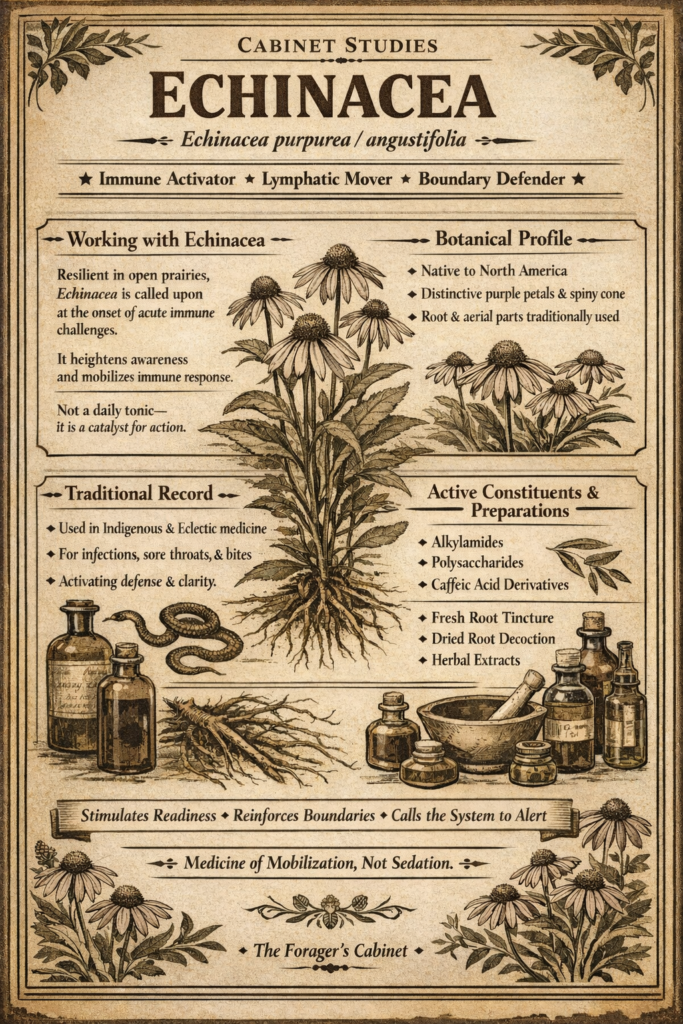
CABINET STUDIES
ECHINACEA
Echinacea purpurea / angustifolia
• Immune Activator • Lymphatic Mover • Boundary Defender •
Working with Echinacea
Echinacea grows across open prairies and grasslands, thriving in exposed environments where resilience is essential. Its upright stem and spined central cone reflect both visibility and defense.
This posture mirrors its medicinal role. Echinacea is most often used at the onset of acute immune challenge—when rapid recognition and response are required.
Its action is stimulating but not indiscriminate. Rather than overwhelming the system, echinacea heightens awareness—encouraging immune cells to respond with greater coordination and efficiency.
Its affinity is most closely associated with acute states: sore throat onset, swollen lymph nodes, early-stage infection, and conditions where immune recognition needs reinforcement.
It is not a daily tonic for weakness. It is a catalyst for response.
Botanical Profile
Echinacea species are native to North American prairies and dry open fields.
They produce distinctive purple petals that radiate downward from a raised, spiny cone—an unmistakable structure that has become emblematic of herbal immune support.
The root and fresh aerial parts are traditionally used, depending on species and preparation.
Its root carries a tingling, numbing sensation when tasted—reflecting the alkylamide compounds that contribute to its immune-modulating properties.
Its structure is firm, upright, and resilient—echoing its role in strengthening biological defense.
Traditional Record
Echinacea holds a strong place in North American herbal traditions, including Indigenous medicine systems.
It was traditionally used for snakebite, infected wounds, sore throats, and systemic infections—conditions requiring mobilization of defense and containment of spread.
Eclectic physicians of the 19th and early 20th centuries used echinacea extensively for septic states and immune dysregulation.
Its historical role was not to suppress symptoms but to stimulate defensive clarity—encouraging the body to respond decisively.
Its use reflects activation—bringing sluggish immune terrain into alertness.
Active Constituents
Echinacea contains naturally occurring compounds that contribute to its immune-supportive activity:
Alkylamides, interacting with immune cell signaling and inflammatory modulation
Polysaccharides, supporting immune activation
Caffeic acid derivatives (including echinacoside), contributing antioxidant activity
Glycoproteins, influencing immune response
Volatile compounds, supporting local antimicrobial activity
Together, these constituents help mobilize immune defense, enhance recognition of pathogens, and support acute response coordination.
Preparation Methods
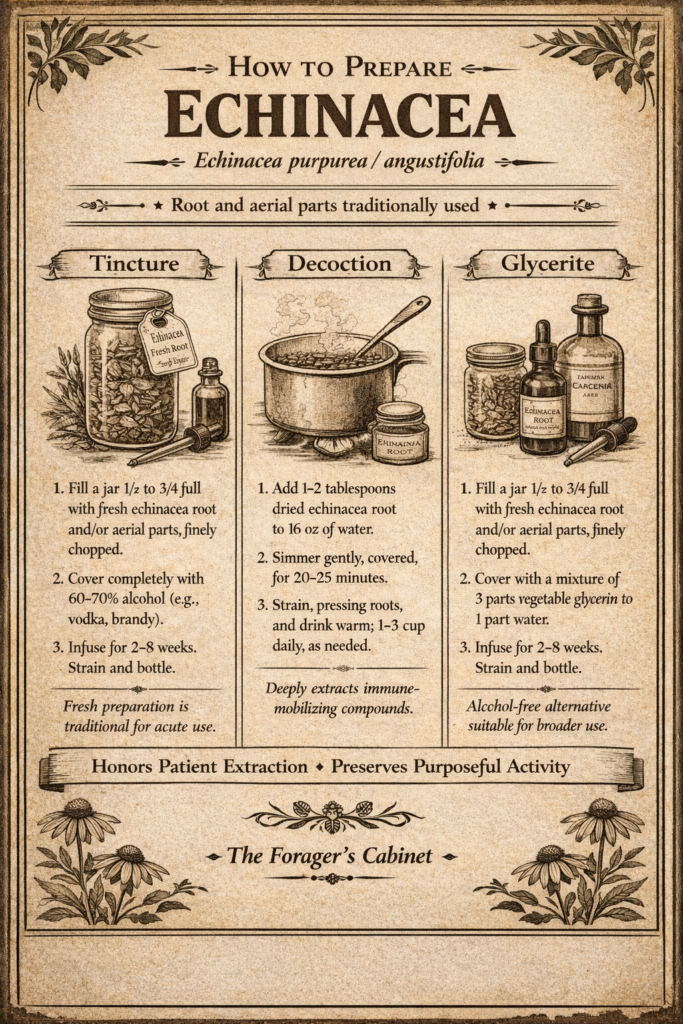
Echinacea may be prepared in several traditional forms:
Fresh Root Tincture
Alcohol extraction of fresh root, traditionally favored for acute immune activation.
Dried Root Decoction
Simmered preparation supporting deeper immune and lymphatic movement.
Fresh Pressed Juice
Historically used to preserve the vitality of the plant’s active constituents.
Glycerite
Alcohol-free preparation suitable for broader use.
Each preparation emphasizes echinacea’s role as a boundary-strengthening and response-mobilizing botanical.
Cabinet Observations
Echinacea corrects immune hesitation.
Where recognition has dulled, it sharpens.
Where response has slowed, it mobilizes.
Where invasion has begun, it reinforces threshold defense.
Its medicine is one of activation.
It does not sedate. It alerts.
It does not suppress. It coordinates.
It does not rebuild long-term reserves. It calls the system forward.
Modern Context
Modern immune systems are often either overstimulated or under-responsive—exposed to chronic stress, environmental strain, and irregular rest.
Echinacea is traditionally used at the onset of imbalance—when early intervention can shift trajectory.
Its value lies not in continuous daily use, but in timely administration during acute phases.
When used appropriately, it supports resilience without dependency.
Its continued relevance reflects its precision in short-term immune modulation.
Safety Record
Echinacea is traditionally regarded as safe for short-term use when properly prepared.
It is not typically used continuously for extended periods.
Individuals with autoimmune conditions or complex immune disorders should seek professional guidance before use.
As with all herbal materials, correct identification, preparation, and storage are essential.
Closing Reflection
Echinacea stands upright in open fields.
It does not hide from exposure.
It strengthens under pressure.
Its medicine awakens what has dulled.
It mobilizes what has stagnated.
It reinforces the line between self and intrusion.
Where defense has faltered, echinacea restores readiness.
© 2026 The Forager’s Cabinet — All Rights Reserved
Educational and Personal Responsibility Disclaimer
All content provided by The Forager’s Cabinet is intended for educational and informational purposes only. These materials reflect traditional herbal knowledge, historical record, and personal study, and are not intended as medical advice or as a substitute for professional healthcare. The preparation and use of any herbal or natural remedy is the sole responsibility of the individual. The Forager’s Cabinet assumes no liability for any adverse effects, injury, or misuse resulting from the application of information presented. Always ensure proper plant identification, follow safe preparation practices, and consult a qualified healthcare professional when appropriate.