MULLEIN {Verbascum thapsus}
Mullein is a resilient flowering plant long associated with respiratory restoration, tissue protection, and structural support. Rich in soothing mucilage, protective flavonoids, and supportive plant compounds, it has been used in herbal practice to calm irritation, reinforce delicate respiratory tissues, and support the body’s natural clearing and repair processes. Traditionally prepared as teas, oils, and tinctures, mullein works by protecting and restoring the body’s internal barriers—helping weakened or exposed systems regain stability. As a preparation, mullein reflects protection—strengthening vulnerable pathways and supporting the body’s gradual return to comfort, balance, and resilience.
CABINET STUDIES
MULLEIN
Verbascum thapsus
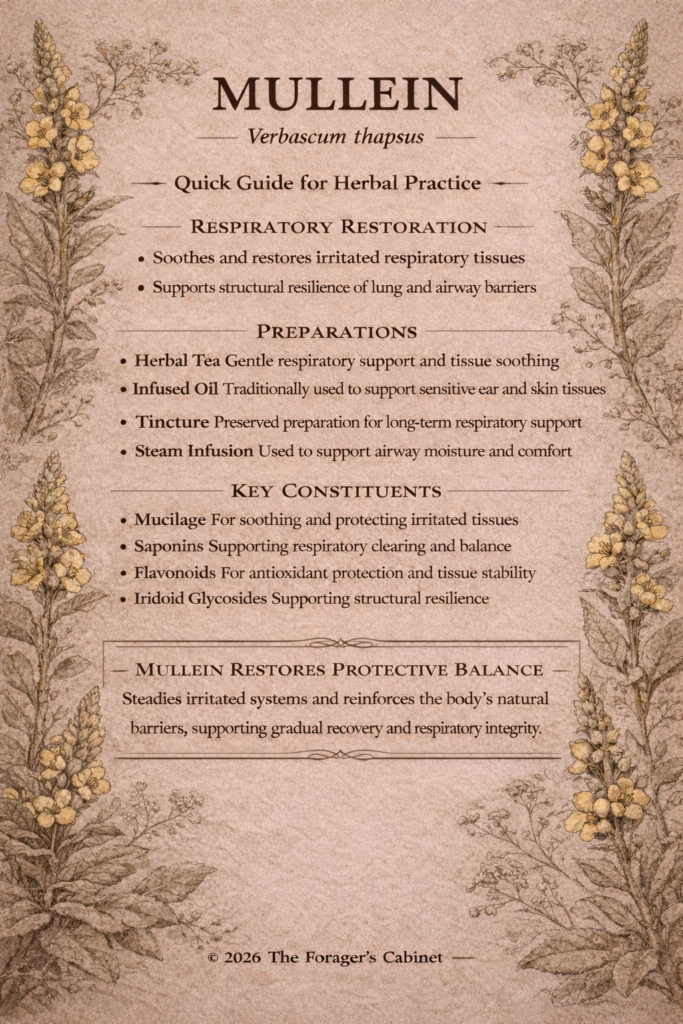
• Respiratory Restorative • Barrier Protector • Structural Support
Working with Mullein
Mullein establishes itself where the land has been disturbed—roadsides, clearings, and exposed soils where few other plants willingly take root. In its first year, it forms a low rosette of soft leaves, drawing inward and strengthening its foundation. In its second year, it rises into a tall central stalk, steady and unmistakable.
This pattern reflects its medicinal role. Mullein supports systems weakened by irritation, exposure, or prolonged strain—particularly those associated with breath, barrier tissues, and structural vulnerability.
Its action is not forceful. Rather than suppressing symptoms, mullein soothes irritation, reinforces protective linings, and supports gradual restoration. It creates conditions that allow sensitive tissues to recover stability and function.
Its affinity is most closely associated with seasons of cold air, dryness, smoke exposure, or respiratory strain—when the body’s protective barriers require reinforcement.
Botanical Profile
Mullein is a biennial plant native to Europe, Asia, and North Africa, now widely naturalized across temperate regions of North America. It thrives in disturbed soils, open fields, roadsides, and transitional landscapes.
In its first year, mullein forms a basal rosette of broad, velvety leaves, pale green to silver in color. These leaves are densely covered in fine hairs, giving them their characteristic softness.
In its second year, a tall flowering stalk emerges, often reaching 4–7 feet in height. Small yellow flowers open sequentially along the upper portion of the stalk over several weeks.
The leaves and flowers are the primary medicinal parts, each containing compounds that support tissue protection and restoration.
Its soft, insulating structure reflects its protective function—shielding vulnerable surfaces from environmental stress.
Traditional Record
Mullein has been used across numerous herbal traditions as a primary support for respiratory and structural systems. It was traditionally prepared as teas, infused oils, and smoke preparations to support lung health and ease irritation.
Its use reflects its role as a barrier restorative—protecting delicate tissues while supporting their recovery.
Mullein leaves were often used to soothe dry, irritated respiratory passages, while mullein flower oil was prepared for external applications involving the ears and sensitive tissues.
Rather than forcing rapid change, mullein was relied upon to restore balance gradually, allowing inflamed or weakened tissues to regain stability.
Active Constituents
Mullein contains naturally occurring compounds that contribute to its protective and restorative properties:
- Mucilage, which forms a soothing, protective layer over irritated tissues
- Saponins, supporting the movement and clearance of accumulated materials
- Flavonoids, offering antioxidant and tissue-protective effects
- Iridoid glycosides, contributing to tissue stability and resilience
- Volatile compounds, supporting gentle antimicrobial balance
Together, these constituents help soothe irritation, protect vulnerable tissues, and support structural recovery.
Preparation Methods
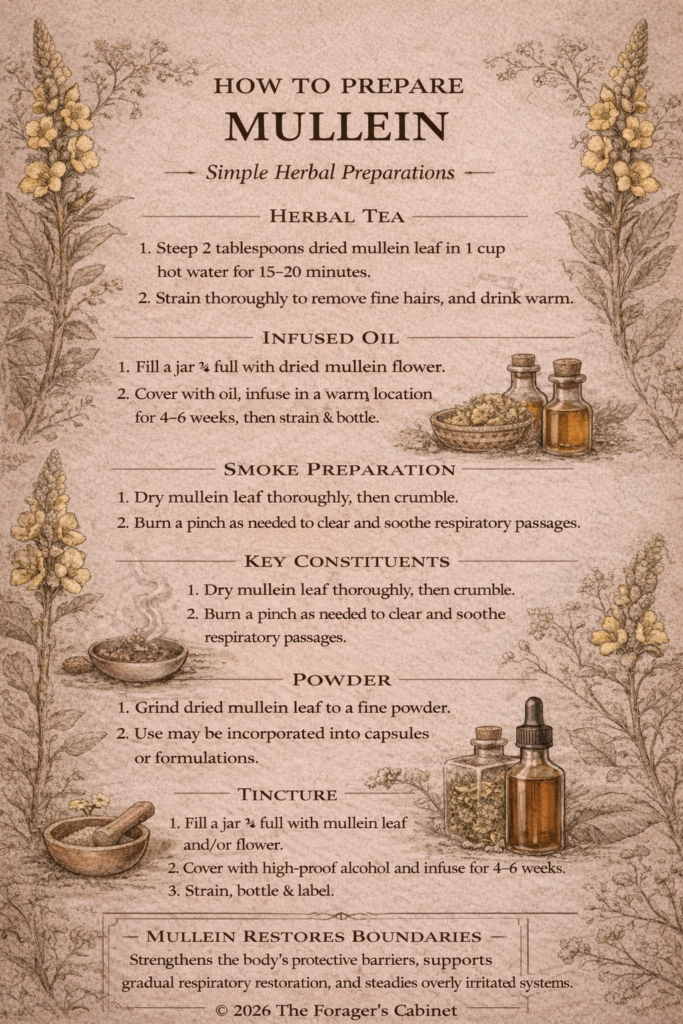
Mullein may be prepared in several traditional forms, depending on intended use:
- Tea or Infusion
Prepared to support respiratory comfort and internal tissue soothing. - Infused Oil
Traditionally prepared from the flowers for external applications involving sensitive tissues. - Smoke Preparation (Traditional Use)
Historically used to support respiratory clearing and structural lung support. - Powder
Incorporated into formulations where extended shelf stability is required. - Tincture
Prepared to preserve active constituents for long-term use.
Each preparation emphasizes mullein’s role as a protective and restorative botanical.
Cabinet Observations
Mullein protects by reinforcing boundaries. Its presence stabilizes tissues that have become weakened, irritated, or overly exposed.
Its structure reflects this function—soft yet resilient, protective yet enduring. It does not force adaptation but creates conditions where natural repair can occur.
It appears where disruption has occurred, restoring stability to vulnerable environments.
This makes mullein particularly suited for preparations intended to protect and restore respiratory and barrier tissues exposed to prolonged stress.
Modern Context
Modern environments expose respiratory and barrier systems to continuous strain—dry indoor air, airborne irritants, pollution, and seasonal illness cycles.
These conditions gradually weaken protective linings and structural resilience.
Mullein offers traditional support for maintaining tissue integrity under these conditions—soothing irritation while reinforcing protective function.
Its continued use reflects its compatibility with long-term respiratory and structural support.
Safety Record
Mullein is traditionally regarded as safe and well tolerated when properly prepared.
Leaves should be strained carefully when used internally, as fine surface hairs may cause mechanical irritation if not removed.
As with all herbal materials, proper identification, preparation, and storage are essential.
Closing Reflection
Mullein grows where the ground has been opened.
It does not avoid exposure. It stabilizes it.
Its medicine does not impose change, but restores protection—strengthening the body’s barriers so that recovery can occur without force.
Where irritation has lingered, mullein restores calm.
Where vulnerability has emerged, it reinforces structure.
Where exposure has weakened defenses, it rebuilds quiet resilience.
© 2026 The Forager’s Cabinet — All Rights Reserved
Educational and Personal Responsibility Disclaimer
All content provided by The Forager’s Cabinet is intended for educational and informational purposes only. These materials reflect traditional herbal knowledge, historical record, and personal study, and are not intended as medical advice or as a substitute for professional healthcare. The preparation and use of any herbal or natural remedy is the sole responsibility of the individual. The Forager’s Cabinet assumes no liability for any adverse effects, injury, or misuse resulting from the application of information presented. Always ensure proper plant identification, follow safe preparation practices, and consult a qualified healthcare professional when appropriate.