WILD CHERRY BARK {Prunus serotina}
Wild Cherry Bark is a traditional woodland botanical long associated with respiratory modulation, nervous system settling, and reflex regulation. Rich in naturally occurring cyanogenic glycosides, flavonoids, and bitter constituents, it has been used in herbal practice to calm persistent cough, regulate irritated reflexes, and support the body’s coordinated respiratory rhythm. Traditionally prepared as syrups, teas, and tinctures, wild cherry bark works not by suppression alone, but by moderating overactivity—helping strained systems return to steadier function. As a preparation, wild cherry reflects regulation—tempering excess, easing spasm, and restoring composure to reactive pathways.
CABINET STUDIES
WILD CHERRY BARK
Prunus serotina
• Respiratory Modulator • Reflex Regulator • Nervous System Settler
Working with Wild Cherry
Wild cherry grows along forest edges and transitional woodlands—spaces where light meets canopy and systems overlap. It establishes quietly among stronger growth, contributing balance rather than dominance.
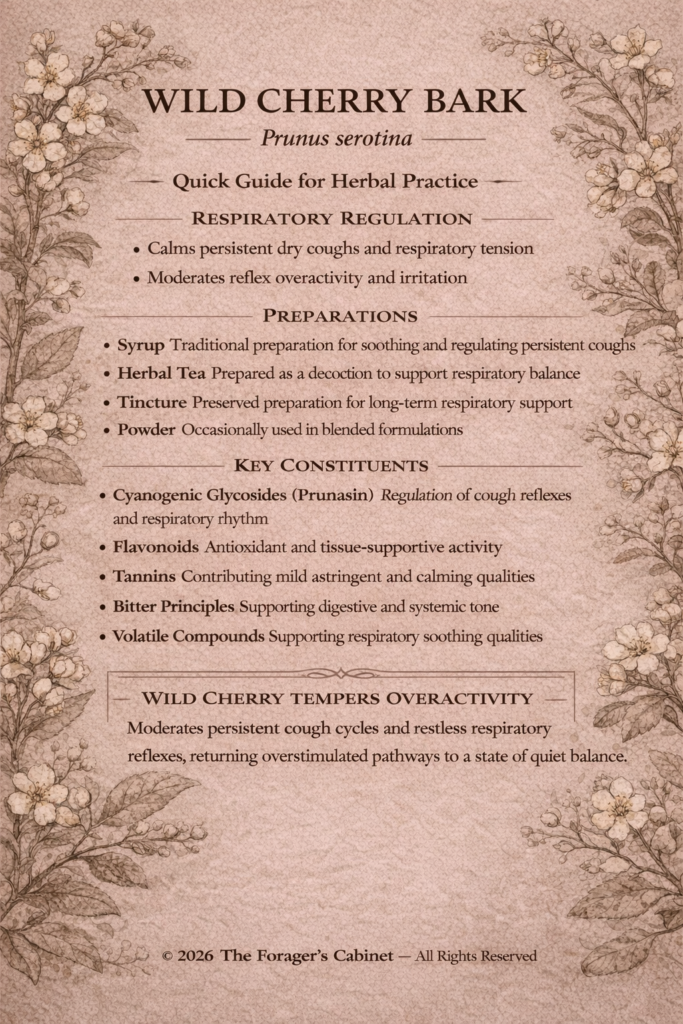
Its medicinal role mirrors this pattern. Wild cherry supports systems that have become overstimulated, particularly those involving cough reflex, bronchial irritation, and nervous tension accompanying respiratory strain.
Its action is regulatory rather than forceful. Instead of aggressively clearing or stimulating, it moderates persistent reflex patterns—especially dry, irritable, nonproductive coughs that linger after acute illness.
Its affinity aligns with seasons of cold air, residual inflammation, and prolonged cough cycles—when respiratory tissues require calming more than stimulation.
Botanical Profile
Wild Cherry (Prunus serotina) is a deciduous tree native to eastern North America. It thrives in forest margins, disturbed woodland edges, and open transitional zones.
The bark of young branches and trunks is the primary medicinal material. It is dark, aromatic, and slightly bitter with a characteristic almond-like scent when freshly cut.
The tree produces clusters of small white flowers in spring, followed by dark purple to black fruits in late summer.
The bark’s aromatic bitterness reflects its regulatory function—steadying reflexes while supporting respiratory rhythm.
Traditional Record
Wild cherry bark has a long history in North American herbal practice, particularly among Indigenous traditions and early American herbalists.
It was traditionally prepared as syrups and decoctions to calm dry, persistent coughs and soothe irritated bronchial passages.
Its role was not to suppress necessary immune response, but to moderate excessive reflex—especially when coughing became exhausting or unproductive.
Wild cherry was often combined with moistening herbs when tissues were dry, or with expectorants when regulation and clearance were both required.
Its use reflects balance—quieting overactivity while preserving function.
Active Constituents
Wild Cherry Bark contains naturally occurring compounds that contribute to its regulatory properties:
Cyanogenic glycosides (including prunasin), which in small, properly prepared amounts contribute to cough-modulating effects
Flavonoids, offering antioxidant and tissue-supportive activity
Tannins, contributing mild astringent properties
Bitter principles, supporting digestive and systemic tone
Volatile aromatic compounds, contributing to respiratory soothing qualities
Together, these constituents help calm excessive cough reflex, support respiratory comfort, and reinforce balanced function.
Preparation Methods
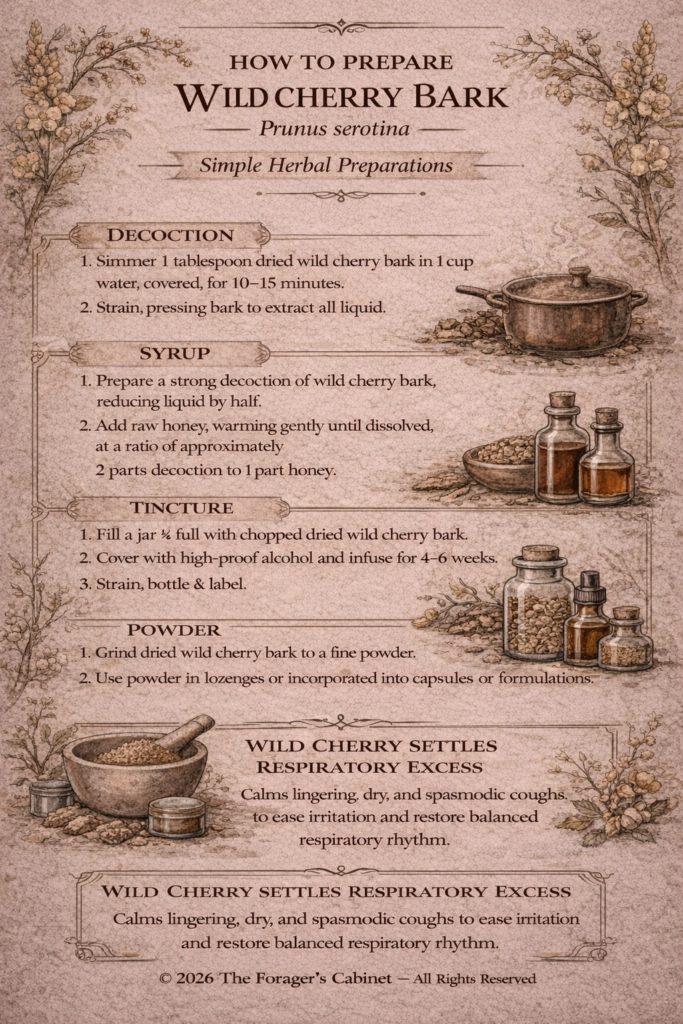
Wild Cherry Bark may be prepared in several traditional forms:
Decoction
Prepared from dried bark to support cough regulation and respiratory comfort.
Syrup
Traditionally combined with honey or other botanicals to create soothing cough formulations.
Tincture
Prepared to preserve active constituents for long-term use and precise dosing.
Powder (Less Common)
Used in blended formulations where synergistic action is desired.
Each preparation emphasizes wild cherry’s role as a moderating and reflex-calming botanical.
Cabinet Observations
Wild cherry tempers excess.
It is particularly suited for cough that persists beyond its usefulness—when reflex continues after irritation has diminished, or when dryness and tension sustain discomfort.
Its action reflects composure. It does not drive the system forward. It slows what has become overactive.
Where stimulation would aggravate, wild cherry settles.
Where exhaustion follows repeated coughing, it restores rhythm.
Modern Context
Modern respiratory strain often extends beyond infection—dry indoor air, environmental irritants, and repeated seasonal illness can leave lingering cough cycles.
In these cases, stimulation alone may not resolve discomfort.
Wild cherry offers traditional support for regulating excessive reflex and calming irritated respiratory pathways, especially in dry or spasmodic presentations.
Its continued use reflects its value in moderating persistent reactivity.
Safety Record
Wild Cherry Bark must be properly dried and prepared before use. Fresh bark contains higher concentrations of cyanogenic compounds and should not be used.
When correctly prepared and used in appropriate amounts, it has a long traditional safety record.
As with all botanicals, proper identification, preparation, and dosing are essential.
Use during pregnancy or with young children should be approached with professional guidance.
Closing Reflection
Wild cherry grows at the forest’s edge.
It does not dominate the landscape.
It moderates it.
Its medicine does not suppress vitality—it restores proportion.
Where cough has become excessive, it quiets.
Where reflex has lingered, it regulates.
Where strain has unsettled rhythm, it restores steadiness.
In its restraint, it teaches balance.
© 2026 The Forager’s Cabinet — All Rights Reserved
Educational and Personal Responsibility Disclaimer
All content provided by The Forager’s Cabinet is intended for educational and informational purposes only. These materials reflect traditional herbal knowledge, historical record, and personal study, and are not intended as medical advice or as a substitute for professional healthcare. The preparation and use of any herbal or natural remedy is the sole responsibility of the individual. The Forager’s Cabinet assumes no liability for any adverse effects, injury, or misuse resulting from the application of information presented. Always ensure proper plant identification, follow safe preparation practices, and consult a qualified healthcare professional when appropriate.