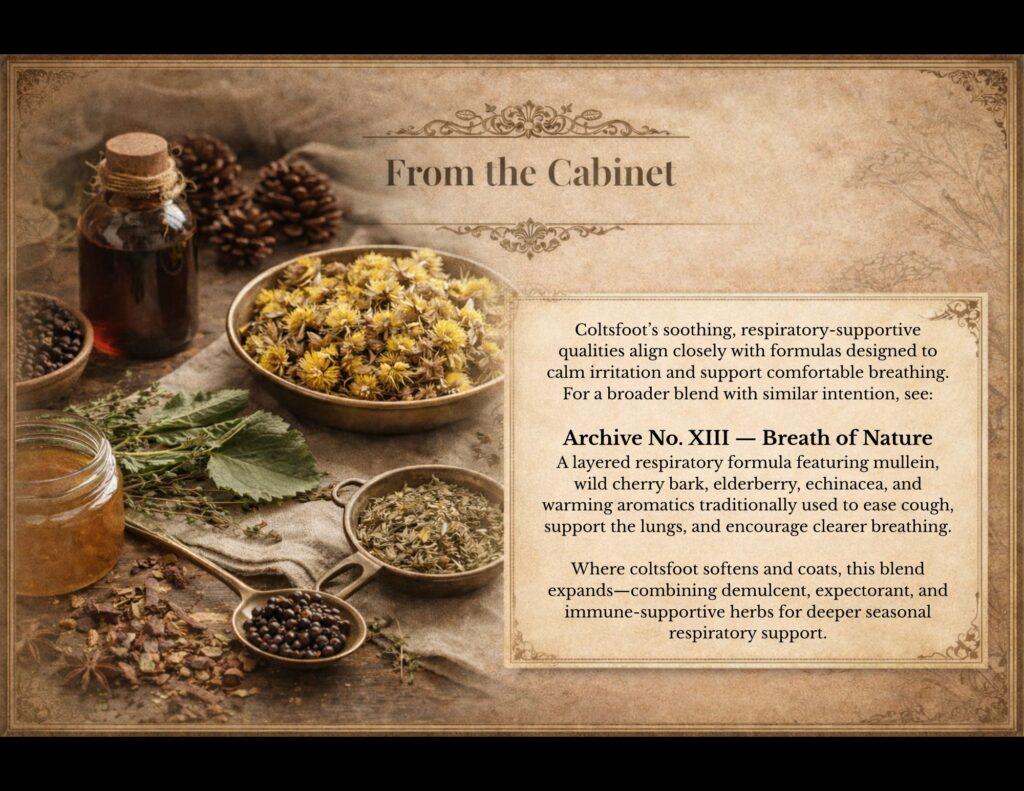
Coltsfoot {Tussilago farfara}
Coltsfoot is an early spring perennial long associated with soothing dry, irritated respiratory tissues. Rich in mucilage, flavonoids, bitter compounds, and soothing polysaccharides, it has been used in herbal practice to calm coughs, ease throat irritation, and support the lungs during dryness or inflammation. Traditionally prepared as infusions, syrups, and honey preparations, coltsfoot works through coating and softening—reducing irritation and encouraging comfortable breathing. As a preparation, coltsfoot reflects relief—quieting persistent cough and easing respiratory tension.
CABINET STUDIES
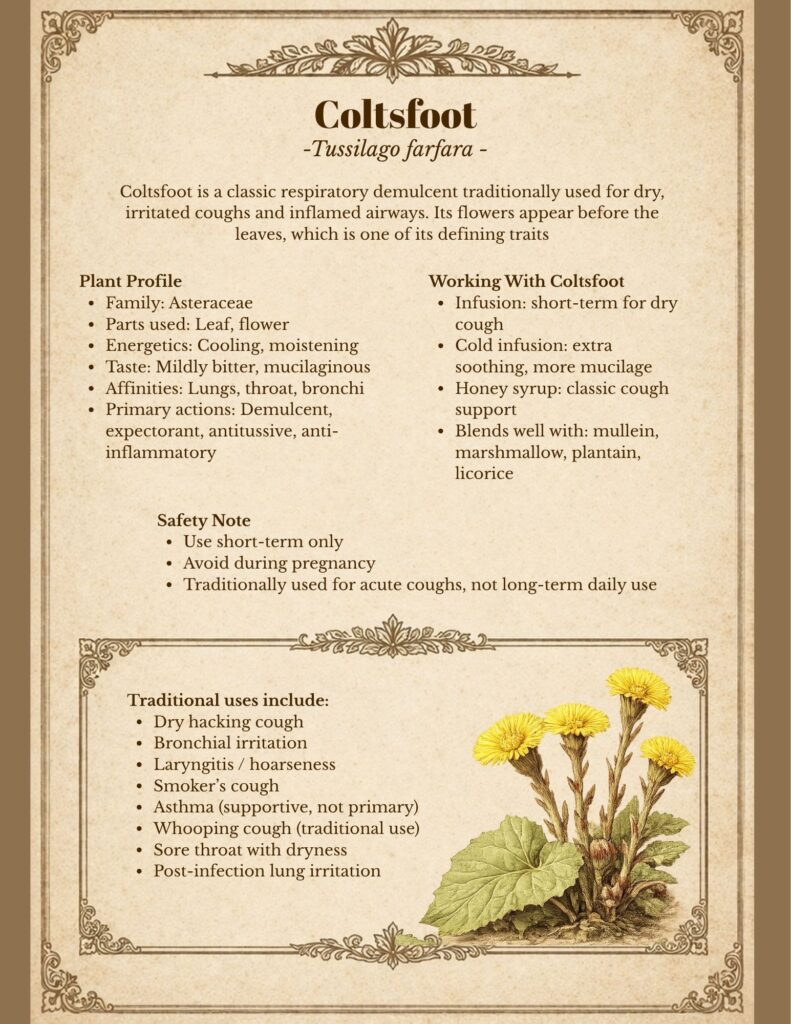
COLTSFOOT
Tussilago farfara
• Respiratory Demulcent • Cough Soother • Lung Moistener •
Working with Coltsfoot
Coltsfoot appears very early in spring, often flowering before its leaves emerge. Bright yellow blooms rise from bare ground, followed later by large, soft leaves.
This unusual growth pattern mirrors its traditional use. Coltsfoot is often reached for at the first signs of dry cough or respiratory irritation — when tissues are dry, reactive, and easily aggravated.
Its action is gentle and coating. Rather than strongly stimulating expectoration, coltsfoot softens irritation and calms the cough reflex. Its affinity is most closely associated with dry cough, throat irritation, bronchial dryness, and lingering respiratory sensitivity.
It is not a strong stimulant.
It is a respiratory soother.
Botanical Profile
Coltsfoot is a low-growing perennial native to Europe and widely naturalized throughout North America. It commonly appears in disturbed soils, roadsides, banks, and damp ground.
Bright yellow, dandelion-like flowers emerge before the leaves. Later, broad, hoof-shaped foliage develops — giving the plant its common name.
The leaf is the primary part traditionally used, though flowers are sometimes included. Its soft, slightly fuzzy texture reflects its soothing nature, while its low, spreading structure echoes its gentle support of the respiratory system.
Traditional Record
Coltsfoot holds a long history in European herbal traditions as a remedy for cough and lung irritation. It was commonly prepared for dry cough, bronchial irritation, hoarseness, and respiratory inflammation.
Infusions and syrups were frequently used for persistent cough and throat dryness. The leaf was also historically smoked or burned as an inhaled preparation for respiratory discomfort.
Its traditional role centers on calming irritation — quieting cough while supporting the lungs.
Its use reflects soothing rather than stimulation.
Active Constituents
Coltsfoot contains naturally occurring compounds associated with its traditional respiratory use:
• Mucilage — coating and demulcent effects
• Flavonoids — supportive anti-inflammatory activity
• Bitter compounds — gentle respiratory toning
• Tannins — mild astringency
• Polysaccharides — soothing irritated mucous membranes
Together, these constituents help calm cough, reduce irritation, and support comfortable breathing.
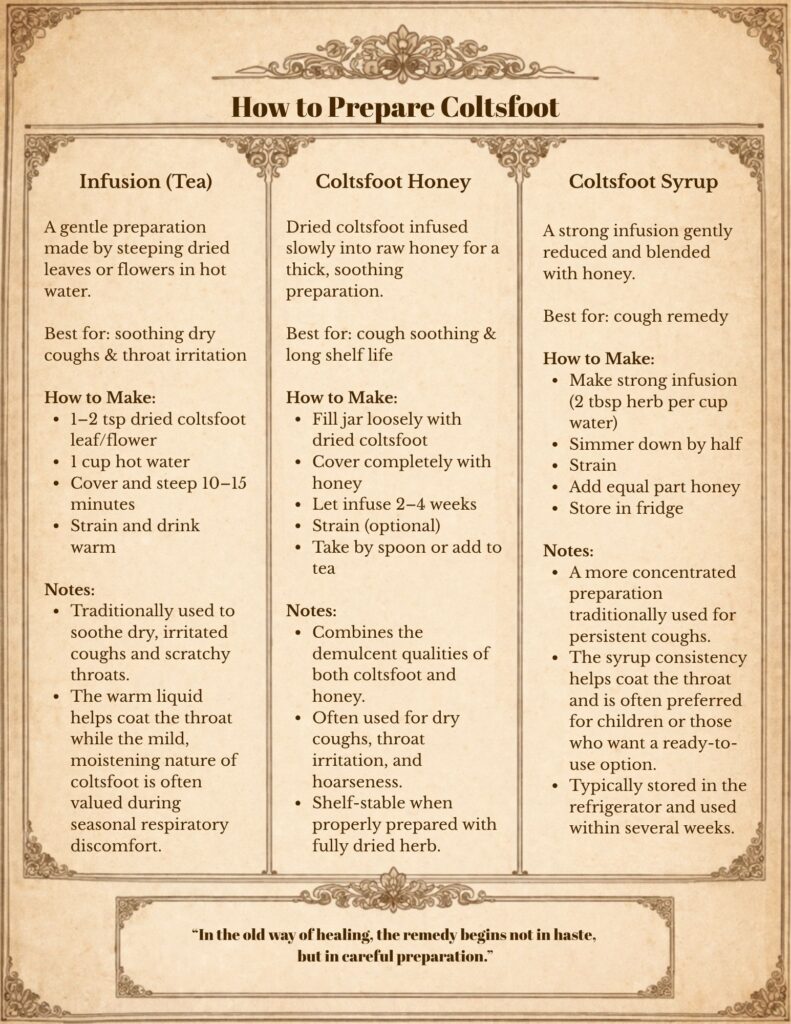
Preparation Methods
Coltsfoot may be prepared in several traditional forms:
Leaf Infusion
To Prepare: Pour hot water over dried coltsfoot leaf, cover, and steep 10–15 minutes. Strain and drink warm.
Traditional Uses:
• Dry cough
• Throat irritation
• Bronchial dryness
Coltsfoot Syrup
To Prepare: Make a strong infusion of coltsfoot leaf, strain, then combine with honey while warm to create a thick syrup. Refrigerate.
Traditional Uses:
• Persistent cough
• Hoarseness
• Lingering respiratory irritation
Infused Honey
To Prepare: Cover dried coltsfoot leaf completely with raw honey and allow to infuse 1–2 weeks. Strain if desired.
Traditional Uses:
• Throat dryness
• Scratchy voice
• Mild cough irritation
Steam Infusion
To Prepare: Place coltsfoot leaf in a bowl, pour steaming water over it, and inhale the vapor under a towel for several minutes.
Traditional Uses:
• Dry air irritation
• Bronchial sensitivity
• Respiratory comfort
Each preparation emphasizes coltsfoot’s role as a soothing respiratory botanical.
Cabinet Observations
Coltsfoot quiets irritation.
Where cough is persistent, it calms.
Where tissues are dry, it moistens.
Where breathing is strained, it softens.
Its medicine is one of relief.
It does not stimulate strongly — it soothes.
It does not dry — it coats.
It does not push — it quiets.
Modern Context
Dry indoor air, seasonal irritation, and environmental exposure commonly affect the respiratory system. Coltsfoot is traditionally used when cough is dry, irritated, and persistent.
Its value lies in calming reactivity without heaviness. When used appropriately, it supports comfortable breathing while easing irritation.
Its continued relevance reflects its gentle respiratory support.
Safety Record
Coltsfoot is traditionally used in small amounts and short-term preparations. Only properly identified, high-quality material should be used.
Coltsfoot contains pyrrolizidine alkaloids, and many modern sources recommend caution with internal use unless PA-free material is used. Avoid long-term continuous use.
As with all herbs, correct identification and preparation are essential.
Closing Reflection
Coltsfoot rises before the leaves.
It appears when the ground is still cold.
It softens the edge of early spring.
Its medicine quiets what is irritated.
It moistens what is dry.
It calms what will not settle.
Where cough persists, coltsfoot brings relief.
© 2026 The Forager’s Cabinet — All Rights Reserved
Educational and Personal Responsibility Disclaimer
All content provided by The Forager’s Cabinet is intended for educational and informational purposes only. These materials reflect traditional herbal knowledge, historical record, and personal study, and are not intended as medical advice or as a substitute for professional healthcare. The preparation and use of any herbal or natural remedy is the sole responsibility of the individual. The Forager’s Cabinet assumes no liability for any adverse effects, injury, or misuse resulting from the application of information presented. Always ensure proper plant identification, follow safe preparation practices, and consult a qualified healthcare professional when appropriate.