WITCH HAZEL {Hamamelis virginiana}
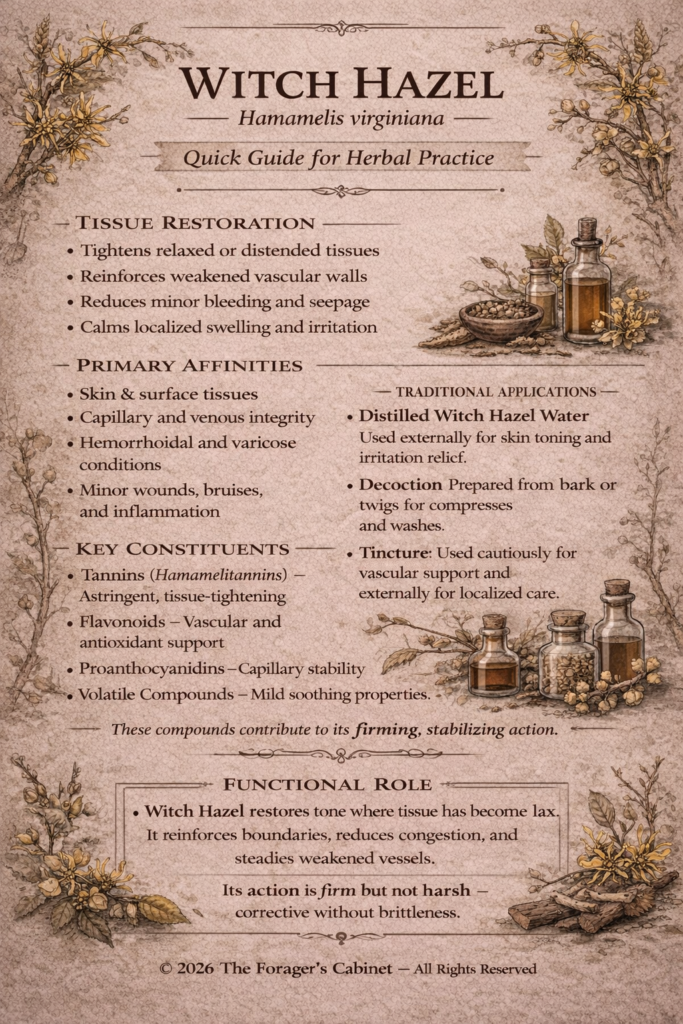
Witch Hazel is a deciduous woodland shrub long associated with tissue toning, vascular support, and surface restoration. Rich in tannins, flavonoids, and antioxidant compounds, it has been used in herbal practice to tighten relaxed tissues, calm surface irritation, and reinforce weakened vascular structures. Traditionally prepared as distillates, decoctions, and extracts, witch hazel works by strengthening boundaries—helping overstretched or inflamed tissues regain tone and stability. As a preparation, witch hazel reflects contraction—drawing scattered systems inward and restoring structural integrity.
CABINET STUDIES
WITCH HAZEL
Hamamelis virginiana
• Tissue Toner • Vascular Support • Surface Restorative
Working with Witch Hazel
Witch hazel grows along forest margins and stream banks, thriving in transitional landscapes where moisture and structure must remain balanced. Unlike many flowering shrubs, it blooms in late autumn—when other growth has withdrawn.
This timing reflects its medicinal role. Witch hazel supports tissues that have become lax, swollen, or irritated—particularly those involving surface structures, capillary integrity, and localized inflammation.
Its action is firm but not harsh. Rather than suppressing function, witch hazel restores tone—tightening relaxed tissues and reinforcing vascular walls.
Its affinity is most closely associated with overextension: minor bleeding, swelling, varicosities, hemorrhoids, surface irritation, and areas where tissue integrity has weakened.
Botanical Profile
Witch Hazel (Hamamelis virginiana) is native to eastern North America and grows as a small understory tree or shrub.
It produces distinctive yellow ribbon-like flowers in late fall, often after leaves have dropped—an uncommon flowering pattern that makes it easily recognizable.
The bark and twigs are the primary medicinal parts, traditionally harvested and distilled or decocted.
Its structure is flexible yet tensile—reflecting its ability to tighten and restore tone without brittleness.
Traditional Record
Witch hazel has a long history of use in North American herbal traditions, including Indigenous medicine.
It was traditionally applied externally as a wash or compress for minor wounds, swelling, bruising, and vascular irritation.
Its role was not to force rapid healing, but to reinforce tissue boundaries—reducing seepage, calming inflammation, and supporting capillary resilience.
Distilled witch hazel water became widely used for skin toning and post-shave care due to its ability to calm irritation and tighten pores.
Its use reflects structural correction—restoring tone where tissues have relaxed or become congested.
Active Constituents
Witch Hazel contains naturally occurring compounds that contribute to its toning and restorative properties:
Tannins (including hamamelitannins), providing astringent and tissue-tightening effects
Flavonoids, supporting vascular integrity and antioxidant protection
Proanthocyanidins, contributing to capillary stability
Volatile oils, offering mild soothing properties
Bitter principles, supporting circulatory tone
Together, these constituents help reduce inflammation, reinforce vascular walls, and restore tissue firmness.
Preparation Methods
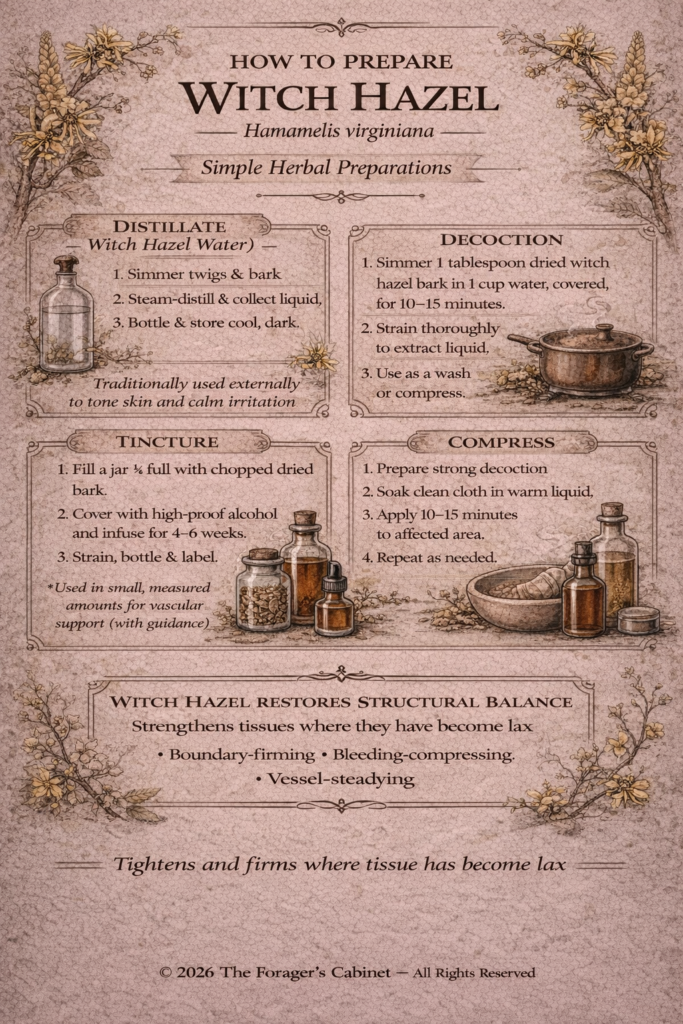
Witch Hazel may be prepared in several traditional forms:
Distillate (Witch Hazel Water)
Steam-distilled preparation traditionally used for external application to tone and calm tissues.
Decoction
Prepared from bark or twigs for use in compresses and washes.
Tincture
Used for both internal vascular support (with professional guidance) and external application.
Poultice or Compress
Applied to areas of localized swelling or irritation.
Each preparation emphasizes witch hazel’s role as a boundary-strengthening botanical.
Cabinet Observations
Witch hazel corrects excess looseness.
Where tissues have become distended, it draws them inward.
Where vessels have weakened, it reinforces them.
Where inflammation has caused seepage or swelling, it restores containment.
Its medicine is one of structure.
It does not soften. It firms.
It does not stimulate. It stabilizes.
Modern Context
Modern lifestyles often contribute to vascular strain—prolonged sitting, pressure, minor injury, and repeated surface irritation.
Environmental exposure and frequent cosmetic intervention may also weaken the skin’s protective tone.
Witch hazel offers traditional support for maintaining structural integrity under these conditions—reinforcing capillary strength and calming superficial inflammation.
Its continued use reflects its compatibility with long-term vascular and surface support.
Safety Record
Witch hazel is traditionally regarded as safe for external use when properly prepared.
Internal use should be approached cautiously and under professional guidance due to its high tannin content.
As with all herbal materials, proper identification, preparation, and storage are essential.
Closing Reflection
Witch hazel flowers when the forest has quieted.
It does not compete for attention.
It restores structure in stillness.
Its medicine gathers what has scattered.
It tightens what has loosened.
It strengthens what has thinned.
Where tissues have relaxed beyond their strength, witch hazel restores their boundaries.
© 2026 The Forager’s Cabinet — All Rights Reserved
Educational and Personal Responsibility Disclaimer
All content provided by The Forager’s Cabinet is intended for educational and informational purposes only. These materials reflect traditional herbal knowledge, historical record, and personal study, and are not intended as medical advice or as a substitute for professional healthcare. The preparation and use of any herbal or natural remedy is the sole responsibility of the individual. The Forager’s Cabinet assumes no liability for any adverse effects, injury, or misuse resulting from the application of information presented. Always ensure proper plant identification, follow safe preparation practices, and consult a qualified healthcare professional when appropriate.